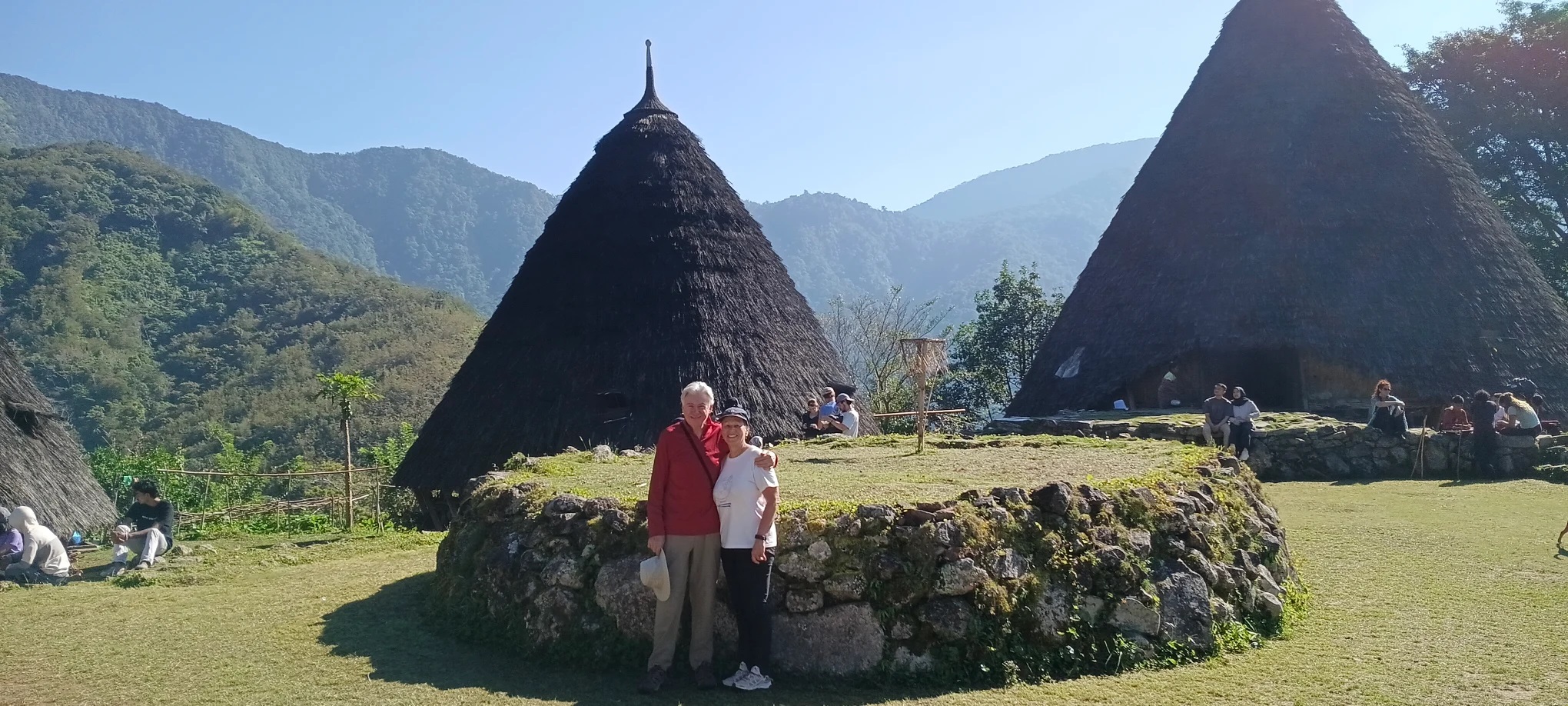
On the first day, we picked Richard and Fren up from the Théodore Hotel in Labuan Bajo and drove for about three hours to Denge Village, the last village accessible by vehicle before the five-kilometre hike to the traditional village of Waerebo. It is a traditional village in Manggarai Regency, on the island of Flores, East Nusa Tenggara Province. The village sits at an altitude of approximately 1,100 metres above sea level, surrounded by the Mandosawu mountain range.
That day, Richard and Fren were probably the oldest couple among the roughly 120 tourists from different countries visiting Waerebo. Richard was 71, while Fren was about five years younger. Despite their age, they completed the five-kilometre hike to Waerebo in less than two hours, arriving about ten minutes ahead of me. That was truly impressive.
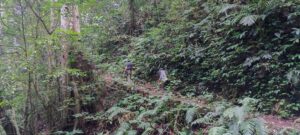
They clearly enjoyed the journey. From time to time, they asked about the flora and fauna along the tropical rainforest trail. I introduced them to several wild forest plants, including different types of ferns and some endemic trees such as Rukus (Adinandra javanica), Kenti (Leptospermum flavescens), Rentigi (Vaccinium timorensis), and Mpuing (Decaspermum fruticosum), among others.
Around the village, we also encountered many agricultural plants, including coffee, corn, cassava, sweet potatoes, taro, cloves, palm trees used to produce tuak, and cinnamon.
“Ino, this is an amazing hike. I really enjoyed it. I felt a little pain in my knees, but it was absolutely worth it for such a beautiful hike,” Fren said when we arrived in Waerebo.
Upon arrival, we went straight to the main house, known as Mbaru Gendang, the communal house of the Waerebo people. This is where the community traditionally gathers to perform rituals and ceremonies. It is also the only house where the traditional gong and drum instruments are kept. Traditionally, every visitor to Waerebo, including Richard and Fren, is formally welcomed here.
From the Mbaru Gendang, we were directed to the guest house, where we had coffee, dinner, and a chance to rest.
During our time in Waerebo, we talked extensively about the history and traditions of the local community.
As an archaeologist, Richard naturally had many questions. I was happy to share everything I knew and understood. From time to time, Richard and Fren also offered academic perspectives related to the cultural practices of the local people.
One topic that I particularly remember discussing was the community’s traditional beliefs and religion.
In addition to Catholicism, which was introduced by European missionaries about a century ago, the local people have their own traditional belief system. They believe in ancestral spirits, spirits that inhabit large trees, spirits that protect springs, spirits that watch over agricultural land, and spirits that protect the places where people live.
Because of these beliefs, they continue to perform traditional offering rituals at certain times, as do many other Manggarai communities. The offerings may include betel nut and betel leaves, sopi (a locally produced alcoholic drink), eggs, chickens, pigs, goats, and, for the most important ceremonies, buffalo.
These offering rituals are particularly common when someone dies, during harvest thanksgiving ceremonies known as Penti, and during ceremonies celebrating the completion of a traditional communal house, known as Congko Lokap. This traditional belief system remains alive today.
Richard and Fren and I continued talking late into the evening until we eventually became sleepy and went to bed.
The next morning, after breakfast, I took my two guests for a walk around the village. We visited a photographic exhibition documenting the construction of the traditional houses, observed the daily activities of the villagers, explored some of the surrounding farmland, and visited a traditional water fountain.
After that, we hiked downhill to the parking area, where Roberto was waiting to drive us to Ruteng.
Our next planned activity was a trek through the rice fields around Ruteng, the capital of Manggarai Regency. However, because Fren’s knee was still bothering her, we decided to take it easy at the hotel where they were staying.
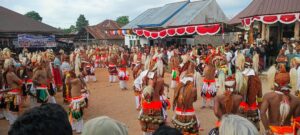
As luck would have it, a Caci performance was taking place just 20 minutes from Ruteng. Caci is a traditional Manggarai dance and martial-arts performance. Without much discussion, we decided to go and watch it.
My two guests seemed delighted and thoroughly enjoyed the performance.
“Ino, it’s really a big day. We love it,” Richard said.
Fren felt the same way. She particularly enjoyed the expressions and personalities of the Caci performers.
“This performance is truly authentic. Every player shows their own character. Some are serious, while others are funny. And their clothes are so colourful. I enjoyed it so much,” she added.
Indeed, Caci is a major cultural event for the Manggarai people. A single performance can involve hundreds of performers coming from different villages. With so many performers and spectators involved, organising a Caci event requires considerable funding.
For that reason, Caci is generally performed during major celebrations, such as Penti, the harvest thanksgiving ceremony; Congko Lokap, the ceremony celebrating the completion of a traditional house; Wagal, a traditional wedding ceremony; and, in modern times, celebrations of Indonesian Independence Day.
After watching the Caci performance, we headed back to our accommodation. On the way, Richard and Fren stopped at a traditional market to buy several Manggarai-style sarongs.
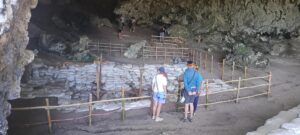
The following day, we visited Liang Bua Cave, commonly known as the Hobbit Cave. The cave is famous for the discovery of ancient human and animal remains dating back roughly 50,000 to 100,000 years on western Flores. The most significant discovery there was the fossil remains of Homo floresiensis, an extinct species of early human.
As a professor of archaeology, Richard did not have too many questions. He had already read extensively about the site and knew most of the story. He simply wanted to see the place with his own eyes. Instead, I was the one asking most of the questions. Fortunately, Richard was happy to answer them.
One question I remember asking was:
- Are we Manggarai people—or at least the people living around the Hobbit Cave—descendants of Homo floresiensis?
According to Richard, there is currently no. There is no clear and strong evidence of a genetic connection between the Manggarai people and Homo floresiensis. Modern Manggarai people are Homo sapiens, with a much more complex genetic history.
Excavations at Liang Bua have continued since Homo floresiensiswas discovered in 2003. Why are researchers still excavating the cave every year?
According to Richard, each excavation should ideally be designed to answer specific research questions—questions that researchers believe can be addressed through further excavation. However, he could not say for certain what major new discoveries might emerge after more than 20 years of excavation.
Richard and I talked at length about Homo floresiensis and many other archaeological questions. But as someone without a strong academic background in archaeology, I wasn’t able to remember or record everything we discussed.
From Liang Bua, or the Hobbit Cave, Richard and Fren returned to Labuan Bajo. The tour was over. I have been doing this work for ten years. I keep repeating the same routes and visiting many of the same places. But somehow, every journey is different, because every client brings a different story and a different atmosphere.
This time, Richard and Fren gave me much more than just a job. They shared with me so many new perspectives on human beings, culture, history, and the natural world. And for that, I am grateful. What a double jackpot!